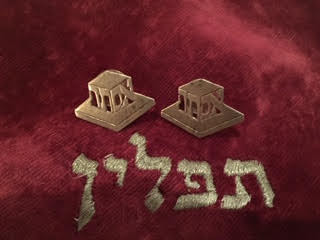
3 - What is in the Batim, the boxes, of the Tefillin?
There are four Biblical passages, written on parchment, referred to as parshiyot, in the tefillin, which serve as a reminder of four basic principles in Judaism:
- Exodus 13:1-10 - Our obligation to remember the Exodus from Egypt
- Exodus 13: 11-16 - Our obligation to transmit the tradition to our childre
- Deuteronomy 6:4-9 - God’s unity and our mutual bond of lov
- Deuteronomy 11:13-21 - Declaration of a person’s responsibility to God.
4 - What does it say in Exodus 13:1-10?
(1) And the LORD spoke unto Moses, saying:
(2) ’Sanctify unto Me all the first-born, whatsoever opens the womb among the children of Israel, both of man and of beast, it is Mine.’
(3) And Moses said unto the people: ‘Remember this day, in which you came out from Egypt, out of the house of bondage; for by strength of hand the LORD brought you out from this place; there shall no leavened bread be eaten.
(4) This day you go forth in the month Abib.
(5) And it shall be when the LORD shall bring you into the land of the Canaanite, and the Hittite, and the Amorite, and the Hivite, and the Jebusite, which God swore to your ancestors to give you, a land flowing with milk and honey, that you shalt keep this service in this month.
(6) Seven days you shalt eat unleavened bread, and in the seventh day shall be a feast to the LORD.
(7) Unleavened bread shall be eaten throughout the seven days; and there shall no leavened bread be seen with you, neither shall there be leaven seen with you, in all your borders.
(8) And you shall tell your child on that day, saying: It is because of that which the LORD did for me when I came forth out of Egypt.
(9) And it shall be for a sign on your hand, and for a memorial between your eyes, that the law of the LORD may be in your mouth; for with a strong hand has the LORD brought you out of Egypt.
(10) You shall therefore keep this ordinance in its season from year to year.
5 - What does it say in Exodus 13:11-16?
(11) And it shall be when the LORD shall bring you into the land of the Canaanite, as God swore to you and to your ancestors, and shall give it you,
(12) that you shall set apart to the LORD all that opens the womb; every firstling that is a male, which you have coming of a beast, shall be the LORD’s.
(13) And every firstling of a donkey you shall redeem with a lamb; and if you wilt not redeem it, then you shall break its neck; and all the first-born of man among your sons shall you redeem.
(14) And it shall be when your child asks you in time to come, saying: What is this? that you shall say to the child: By strength of hand the LORD brought us out from Egypt, from the house of bondage;
(15) and it came to pass, when Pharaoh would hardly let us go that the LORD slew all the firstborn in the land of Egypt, both the first-born of man, and the first-born of beast; therefore, I sacrifice to the LORD all that opens the womb, being males; but all the first-born of my sons I redeem.
(16) And it shall be for a sign upon your hand, and for frontlets between your eyes; for by strength of hand the LORD brought us forth out of Egypt.’
6 - What does it say in Deuteronomy 6:4-9?
(4) HEAR, O ISRAEL: THE LORD IS OUR GOD, THE LORD IS ONE.
(5) And you shall love the LORD your God with all your heart, and with all your soul, and with all your might.
(6) And these words, which I command you this day, shall be on your heart;
(7) and you shall teach them diligently to your children, and shall talk of them when you sit in your house, and when you walk by the way, and when you lie down, and when you rise up.
(8) And you shall bind them for a sign upon your hand, and they shall be for frontlets between your eyes.
(9) And you shall write them upon the door-posts of your house, and upon your gates.
7 - What does it say in Deuteronomy 11:13-21?
(13) And it shall come to pass, if you shall listen diligently to My commandments which I command you this day, to love the LORD your God, and to serve God with all your heart and with all your soul,
(14) that I will give the rain of your land in its season, the former rain and the latter rain, that you may gather in your corn, and your wine, and your oil.
(15) And I will give grass in your fields for your cattle, and you shall eat and be satisfied.
(16) Take care not to be lured away to serve other gods and bow to them.
(17) For the LORD’s anger will flare up against you, and God will shut up the skies so that there will be no rain and the ground will not yield its produce; and you will soon perish from the good land that the LORD is assigning to you.
(18) Therefore, impress these My words upon your very heart: bind them as a sign on your hand and let them serve as a symbol on your forehead,
(19) and teach them to your children—reciting them when you stay at home and when you are away, when you lie down and when you get up;
(20) and inscribe them on the doorposts of your house and on your gates—
(21) to the end that you and your children may endure, in the land that the LORD swore to your ancestors to assign to them, as long as there is a heaven over the earth.
Questions to ponder:
1 – What will you do to prepare for the World Wide Wrap?
2 - Why do you think these 4 passages were chosen to be placed in the Tefillin?
3 – From reading the passages found in the Tefillin, what other mitzvot also derive from the same sections in the Torah?
3 – What does Tefillin personally mean to you? Do you have a connection to the mitzvah of Tefillin? Does this mitzvah speak to you? What else do you want to learn about Tefillin?
4 - Is there another mitzvah you would want to learn about?
Stay Tuned – Future Tefillin 101 Lessons:
- Why are Tefillin black and boxes? Do they have to be? Why?
- What does Tefillin have to do with Love?
- Does God wear Tefillin?
- Are women wearing Tefillin a modern innovation, or did omen do that back in ancient times? (And, if you want to know in advance – the answer is yes – there is Talmudic precedent for women wearing Tefillin.)
Questions before the next installment of Tefillin 101?
 Federation of Jewish Men's Clubs